Stop romanticizing AI. If you think ChatGPT is a "digital brain" or a conscious entity, you have been brainwashed by Silicon Valley marketing. In 2026, failing to understand that these Large Language Models (LLMs) are just massive, cold mathematical functions is a one-way ticket to being replaced. You aren't competing with a genius; you are competing with a high-speed prediction script.
The "magic" everyone keeps talking about is actually just a heavy-duty statistical parlor trick. Under the hood, ChatGPT is a soulless prediction engine. It has been force-fed the entire history of human internet garbage just to guess—with high probability—what the next word fragment should be. It doesn't "know" things. It calculates them.
We are going to stop treating AI like a mystery box. I am going to rip open the transformer architecture and show you the gritty, expensive reality of the training process. I’ll show you exactly why this machine lies to your face (hallucinations) and how you can actually bend it to your will.
Stop talking about "AI" like it's a person. Let's talk about how the machine actually grinds data.
Quick tip: Stop reading theory. Go try to break the machine. Use the latest version at OpenAI ChatGPT. If you can't force it into a logical loop, you're being too polite.
What Is ChatGPT?
ChatGPT is an LLM built by the team at OpenAI. Strip away the hype and you're left with a transformer-based neural network. It's basically a text-prediction tool on heavy-duty steroids. You feed it a prompt, and it scans trillions of language patterns to predict the next "token" (a piece of a word). It is a probability machine, nothing more.
It doesn't have a library of pre-written answers hiding in a folder. It generates every single response, character by character, in real-time. This is why it can debug a messy C++ script and write a passive-aggressive breakup text in the same session. It isn't "finding" information; it is synthesizing statistical patterns.
The era of rigid, boring "if/then" chatbots is dead. We are now in the age of generative intelligence where the only thing that matters is the context you provide.
Further reading: If you want the raw technical blueprint that started this whole mess, read the original GPT-3 research paper and the OpenAI API documentation.
How Does ChatGPT Work?
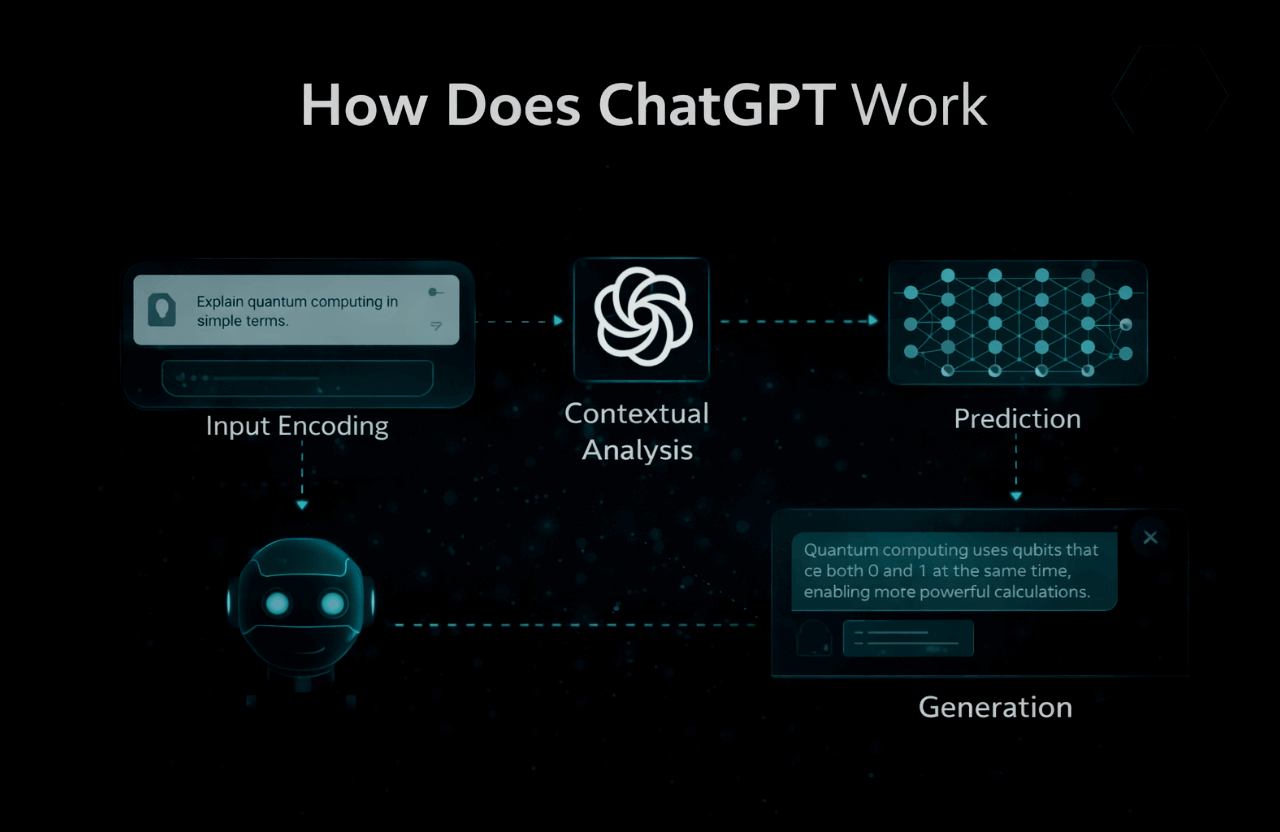
Do not think of it as a mind. Think of it as a massive, multi-dimensional mathematical map. Here is the literal, cold-blooded path your prompt takes inside the engine:
- Tokenization: Your sentence is chopped into "tokens." The machine doesn't read English; it reads numbers. "Apple" is just a number in a sequence to the model.
- Vectorization & Attention: Every token is dropped into a giant mathematical space. The "Attention" mechanism is the secret sauce—it tells the model that the word "bank" in a sentence about a river has nothing to do with the word "bank" in a sentence about a loan.
- Probability Scoring: It runs the numbers for the next possible word. If you type "The sky is...", the math for "blue" hits 98%. The math for "purple" hits 1%. The machine almost always picks the path of least resistance (the highest probability).
- The Loop: It picks a word, adds it to the prompt, and runs the entire multi-billion-parameter calculation again for the next word.
The Transformer Architecture Explained
The "Transformer" is the engine. Before this tech arrived in 2017, AI was painfully slow because it read one word at a time, like a toddler. Transformers changed the game by reading the entire paragraph at once. It sees the whole picture simultaneously.
- Self-Attention: This allows the model to "focus" on the important nouns and verbs while ignoring the "thes" and "ands."
- Multi-Head Attention: The model runs dozens of these attention scans in parallel. One checks for grammar, one for facts, one for sarcasm.
- Layers of Depth: Modern models have nearly a hundred layers. Every layer refines the answer, scrubbing out the noise until it sounds like a human wrote it.
Further reading: For the raw, unfiltered tech specs, go back to the source: Attention Is All You Need.
How Is ChatGPT Trained?
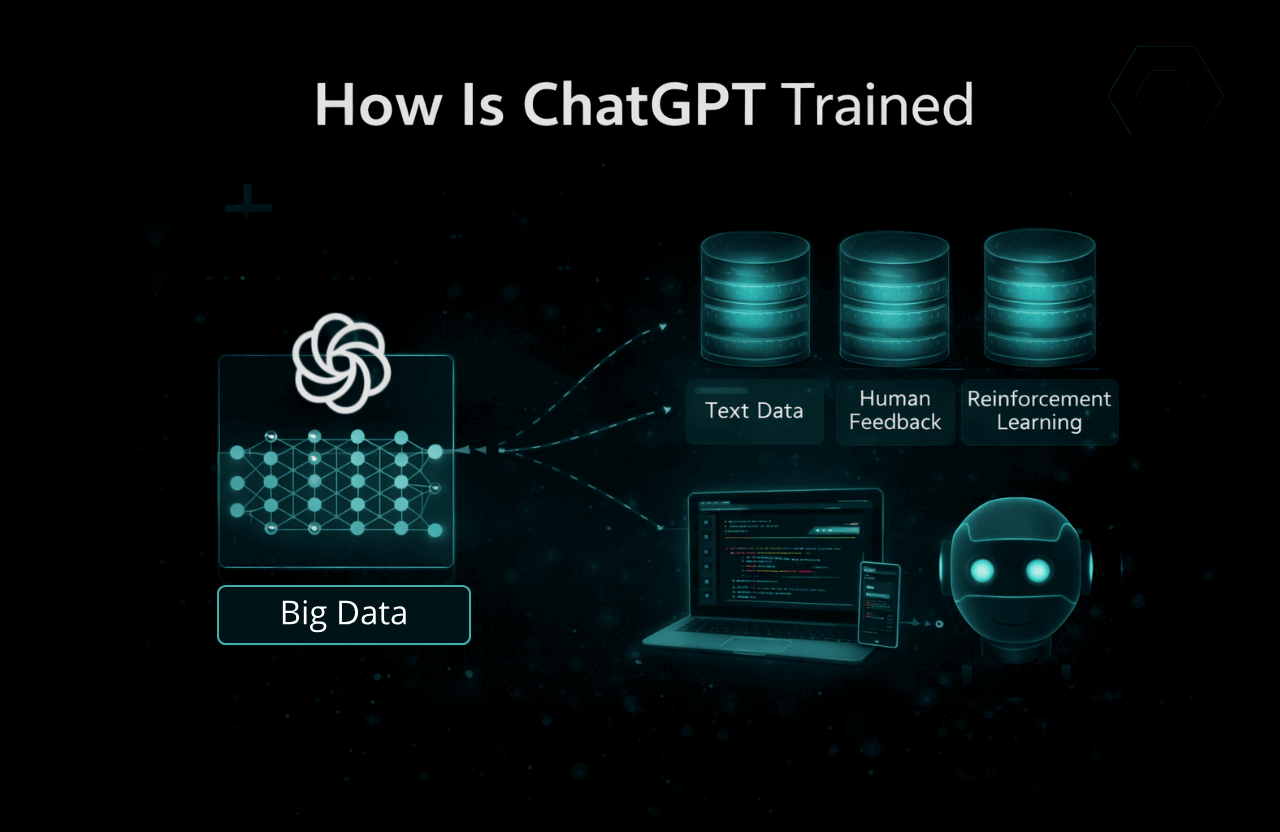
You don't program an LLM with code; you "train" it like an animal through two brutal phases.
1. Pretraining (Massive Data Ingestion)
OpenAI dumps a massive chunk of the internet—Wikipedia, Reddit, GitHub, digitized books—into the machine. The model spends millions of dollars in electricity trying to learn the "vibe" of human language by predicting billions of next words.
- The Goal: Learn the syntax and facts of the world.
- The Scale: Trillions of tokens.
- The Result: A raw, unfiltered model that knows everything but is incredibly chaotic and often rude.
2. Fine-Tuning (The Guardrails)
Raw AI models are dangerous. To make them "polite" enough for the public, they go through RLHF (Reinforcement Learning from Human Feedback). Actual humans sit in a room, compare two AI answers, and click the one that doesn't sound like a psychopath. The machine learns to mimic what humans like.
- Safety Layers: This is why the model refuses to tell you how to hack a bank or build a weapon.
- Alignment: Forcing the AI to actually stay on topic instead of rambling about random Reddit threads.
Resource: Want to see how they "tame" the machine? Read OpenAI's breakdown of Learning from Human Feedback.
What Makes ChatGPT Different from Other Language Models?
The market is crawling with LLMs in 2026. Why is OpenAI still the one everyone talks about?
- The Compute War: OpenAI simply has more raw power and higher-quality data pipelines than 99% of the planet.
- Memory (Context Window): It is generally much better at "remembering" what you said 20 minutes ago without getting confused.
- The Integration: It isn't just a chat box; it's an API, a custom GPT store, and a plugin ecosystem. It's an operating system for AI.
- Aggressive Filtering: It is usually the most "aligned" model, meaning it follows complex, multi-step instructions without breaking character.
Real-World Applications of ChatGPT
If you're only using this to write emails, you're failing. Here is what's actually happening in 2026:
1. Deep Technical Automation
Pros are hooking the API directly into their databases. The AI isn't "chatting"; it's crunching raw data, spotting patterns, and writing SQL queries that would take a human developer three hours to figure out.
2. Content Industrialization
SEO pros use it to build massive content clusters. It drafts, outlines, and optimizes everything. But don't forget, keyword research is still the boss.
3. The Developer's Co-Pilot
Typing out boilerplate code is dead. You generate the raw functions with AI, then spend your time auditing the logic. You've gone from a "writer" to an "editor."
4. High-Speed Research
Sifting through 500-page PDFs is a thing of the past. You dump the document into the model and ask for the three most controversial points. It takes five seconds.
Further reading: Want to push the limits? See what's possible with ChatGPT Plugins.
Limitations and Challenges of ChatGPT
Let's talk about the ugly truth. This machine is a chronic liar.
- Hallucinations: The machine is designed to satisfy you. If it doesn't know an answer, it will often confidently invent a lie. Never trust it blindly.
- The Bias Mirror: It learned from the internet. If the internet is biased, the AI is biased. It just reflects our own mess back at us.
- Zero Reasoning: It doesn't "understand" your business problem. It understands the language patterns used to describe it. There is no logic here, only math.
- Memory Loss: Eventually, the conversation gets too long and the model "forgets" the beginning. It's a mathematical limitation.
Resource: Don't be reckless. Read the Usage Policies before you do something that gets you banned.
How to Use ChatGPT Effectively
Stop asking lazy, one-sentence questions. If you want elite results, you need elite prompts:
- Persona Power: Don't say "write a post." Say "Act as a cynical, 20-year veteran SEO consultant."
- Set Rigid Fences: "Write 500 words. Do not use the word 'delve.' Use short, punchy sentences. Format as Markdown."
- Iterate or Fail: The first response is always the most generic. Critique it. Tell it what it got wrong. Force it to rewrite until it's perfect.
- Double-Check Facts: If it gives you a date or a stat, assume it's a lie until you verify it yourself.
The Future of ChatGPT and Language Models
2026 is the starting line. Here is what is coming next:
- Multimodality: The wall is gone. The model will see your screen, hear your voice, and watch your video in real-time.
- Agentic AI: It won't just tell you how to book a flight; it will log into your account and buy the ticket.
- Zero Latency: Conversations that feel like a real-time phone call, with zero "thinking" pause.
- Private Models: Companies will stop using the "all-knowing" public model and start using tiny, ultra-secure versions trained only on their own private data.
Frequently Asked Questions About ChatGPT
Is it "alive"?
No. It is a sequence of matrix multiplications. It's a complex mathematical function. It has zero consciousness, zero opinions, and zero feelings. It's a tool.
Will it take my job?
It will take the jobs of people who copy-paste from the internet. It will not take the jobs of "engineers" and "creatives" who know how to use it to move 10x faster. Be the one who controls the prompt.
Is my data safe?
If you're on the free plan, OpenAI is likely using your chats to train the next model. If you use the API or Enterprise version, your data is generally walled off. Always read the fine print.
How do I put it on my own site?
You use the OpenAI API. It's a standard REST API. You send a prompt, you get back a JSON object. Simple as that.
Key Takeaways: ChatGPT Language Model Explained
- It is a prediction engine, not a brain.
- The Transformer architecture is what makes it so eerily human.
- Fine-tuning (RLHF) is why it follows your rules and stays polite.
- Hallucinations are a feature, not a bug. Always verify the data.
- The future is Agentic—AI that takes action instead of just talking.
Further Reading and Resources
- OpenAI GPT Guide
- Attention Is All You Need (The Original Paper)
- Best Search Engines Other Than Google
- Keyword Research: The Brutal Truth
- Learn Coding For Kids: The 2026 Blueprint
The AI revolution is here, and it is ruthless. You can either hide from it, or you can master the technical mechanics and use it to leave everyone else in the dust. The machine is waiting. The choice is yours.
Stop reading the surface-level fluff. Dig into the raw technicals. The future belongs to those who control the machine.