
Okay, let's talk real numbers. We all know YouTube is massive, and for a handful of lucky creators, it's essentially a money-printing machine. But what actually happens when you hit that crazy milestone of 1 million views? Do they send you a giant novelty check? If you go around asking different YouTubers, you're going to get wildly different answers. One person might scrape together a thousand bucks, while the next creator casually walks away with $25,000 for the exact same number of clicks. Why is the gap so ridiculous? Because YouTube doesn't actually pay you just for getting views. They pay based on exactly who is watching, what country they live in, and how likely they are to actually buy stuff.
I'm going to break down exactly how much YouTube pays for 1 million views. We’ll look at standard long-form videos versus those rapid-fire YouTube Shorts, and uncover the hidden metrics that turn a random viral moment into a massive payday.
Quick fact: The normal payout for a million monetized views usually sits around $2,000 to $5,000. But depending on who watches your stuff, it can plummet to $1,000 or shoot way past $25,000.
YouTube Earnings Basics: How Monetization Works
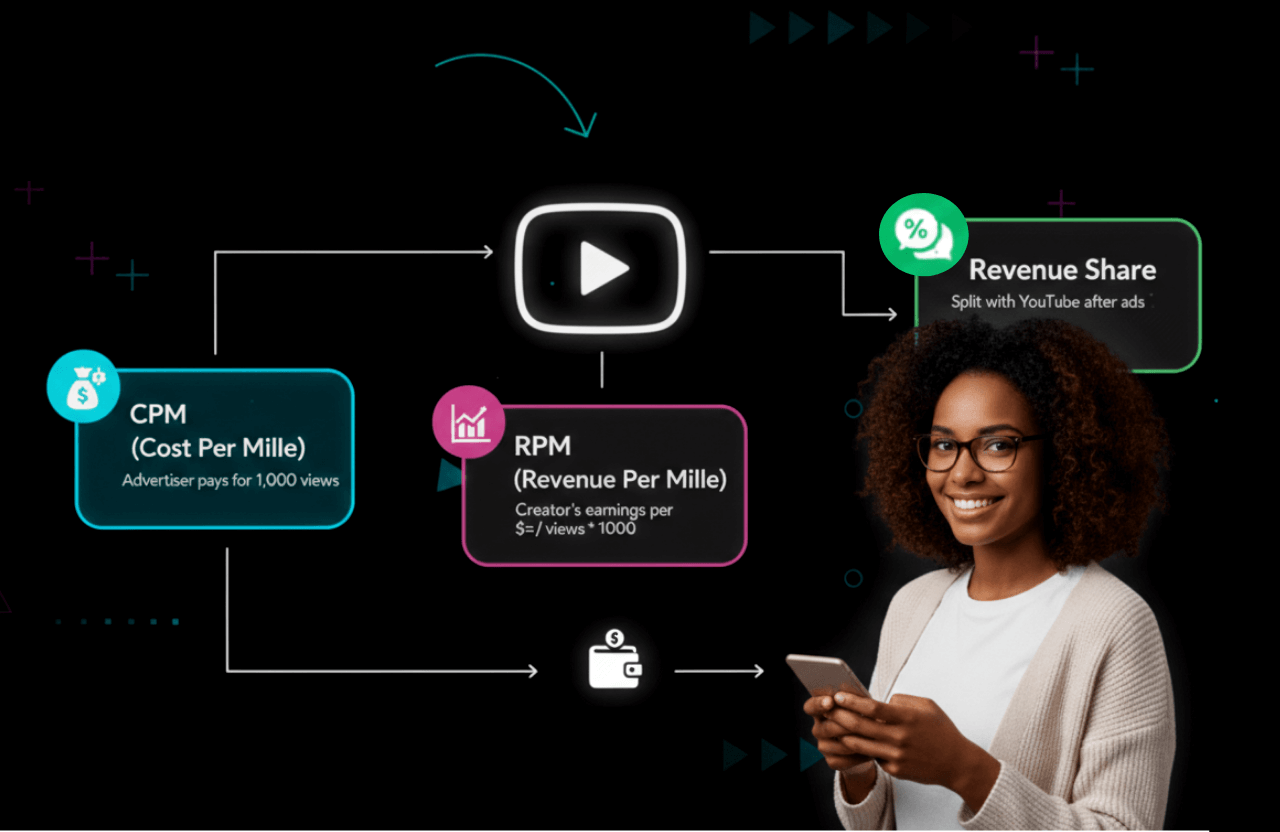
Before you start planning what to do with your YouTube millions, you need to understand how the site actually hands out cash. It all goes through AdSense, which serves up those commercials before and during your videos. The big catch? You only earn a cut of the *monetized* views. Not your total view count.
- CPM (Cost Per Mille): This is the cash big brands are willing to throw down for every 1,000 times their ad pops up. These numbers bounce around constantly depending on the season, your specific topic, and the overall economy.
- RPM (Revenue Per Mille): This is the money that actually lands in your pocket per 1,000 views. It’s calculated after YouTube takes its slice, and it factors in all those views where no ad ever played.
- YouTube’s Revenue Share: YouTube isn't a charity. They keep 45% of the ad money and leave you with 55%.
- Monetized Views: Here is the brutal truth—not every single view makes you cash. Usually, only 40% to 80% of your total views will actually trigger a commercial.
So, when you see a video hit the 1 million mark, the actual paycheck depends entirely on how many of those clicks triggered a commercial, and exactly how much advertisers bid for that specific spot.
Further reading: Want the step-by-step on getting your account approved? Check out How To Get AdSense Approval.
How Much Does YouTube Pay for 1 Million Views?
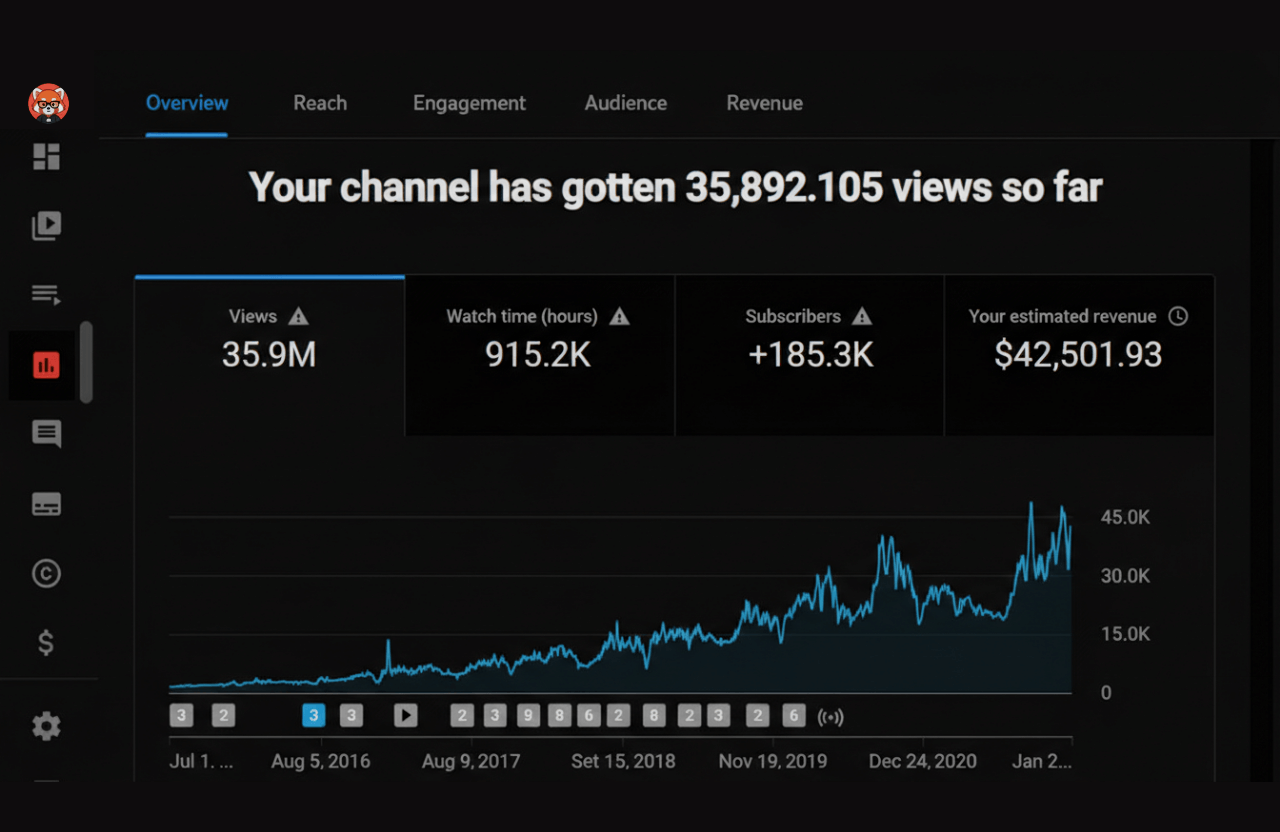
If you just want the quick math without the fluff, here's what the global stats usually show.
For normal long-form videos, most creators end up pocketing somewhere between $2,000 and $5,000 for a million views. That assumes a pretty average Revenue Per Mille (RPM) of about two to five dollars. But things get wild if you run a channel about finance, software, or investing. That payout can easily shoot up to $15,000 or even $30,000.
What about YouTube Shorts? Honestly, the payouts here are basically pocket change compared to normal videos. Creators usually scrape together a measly $10 to $60 for a million Shorts views. It sounds awful, but Shorts are built to go insanely viral, meaning you can rack up millions of views in a fraction of the time.
Quick Earnings Breakdown (Estimates)
Video Type | Average Pay Per 1,000 Views (RPM) | Estimated Pay for 1 Million Views |
|---|---|---|
Gaming / Vlogs | $1.50 - $3.00 | $1,500 - $3,000 |
Entertainment | $2.00 - $5.00 | $2,000 - $5,000 |
Tech / Reviews | $5.00 - $10.00 | $5,000 - $10,000 |
Finance / Business | $15.00 - $30.00+ | $15,000 - $30,000+ |
YouTube Shorts | $0.01 - $0.06 | $10 - $60 |
These ranges aren't just random guesses; they reflect real-world numbers shared by actual creators. The massive gap simply comes down to how advertisers value different types of audiences.
Why Such a Big Range?
- CPM varies by niche: Financial advisors and tech reviewers get CPMs of $15 to $30 because their audience buys expensive things. Prank channels or daily vloggers? They usually survive on $1 to $4.
- Audience location: A view from someone sitting in the US, UK, Australia, or Canada is worth way more to an advertiser than a view from Southeast Asia or Latin America. That's just how ad budgets work.
- Monetized view percentage: If half your fans use ad-blockers, your earnings are going to plummet compared to a channel where 80% of views actually play commercials.
- Ad formats: Unskippable ads, banner ads, bumper ads, and premium spots all pay out completely different amounts.
How to Calculate Your YouTube Earnings for 1 Million Views
Let’s do some quick napkin math to see how this actually plays out:
- Find your average CPM: Jump into your YouTube Analytics and click the Revenue tab. Grab your average CPM from the last 28 days.
- Estimate your monetized view percentage: It usually hovers around 40% to 80%. If you have no idea, 60% is a safe guess.
- Calculate monetized views: Take that 1,000,000 and multiply it by your percentage (so, 1,000,000 x 0.6 = 600,000 views that actually made money).
- Divide by 1,000: 600,000 / 1,000 = 600 units.
- Multiply by CPM: 600 units x a $5 CPM = $3,000 in gross ad revenue.
- Apply YouTube’s 45% cut: Multiply that $3,000 by 0.55, and your final net payout is $1,650.
That’s a totally standard scenario for a general entertainment channel. But plug in a $15 finance CPM with an 80% ad rate, and suddenly you're looking at a cool $6,600 or more.
Pro tip: Just look at your channel’s RPM (Revenue Per Mille) if you want the most brutally honest estimate, since it already accounts for YouTube's cut and dead views.
The Math Behind the Money: RPM vs. CPM
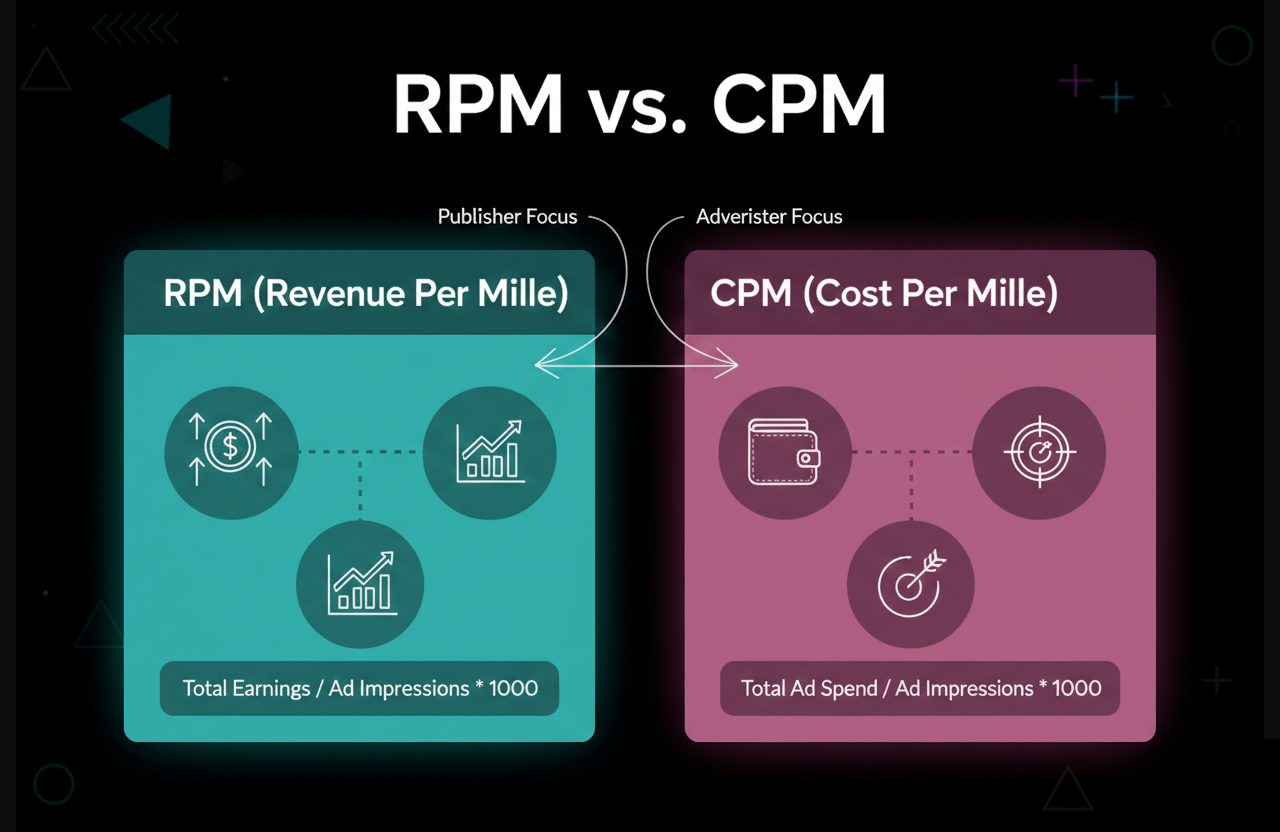
If you really want to figure out your earnings, you have to stop mixing these two acronyms up. Confusing CPM and RPM is the biggest rookie mistake you can make on YouTube.
What is CPM? (Cost Per Mille)
CPM stands for Cost Per Mille (thousand). This is the raw dollar amount advertisers hand over to YouTube for every 1,000 times their ad plays.
Who controls it? The advertising market.
Does it go to you? Nope. That’s the big pie before YouTube grabs its slice.
Why it matters: A sky-high CPM proves that brands are desperate to get their products in front of your viewers.
What is RPM? (Revenue Per Mille)
RPM stands for Revenue Per Mille. This is the money that actually hits your bank account for every 1,000 views your video gets.
Who controls it? Your content strategy, plus whatever YouTube decides to keep.
Does it go to you? Yes. This is your actual paycheck.
The Calculation: RPM calculates what's left after YouTube takes its 45% fee (on long-form content), and it waters down your average by factoring in all the views where an ad never even played (like viewers with ad-blockers or Premium accounts).
The Formula:
Total Revenue ÷ Total Views × 1,000 = RPM
If a video pulls 1,000,000 views and your RPM sits at $5.00, you are making $5,000. If your RPM is a juicy $20.00, you just made $20,000. That is exactly why working on your RPM is arguably more important than just chasing viral views.
Key Factors That Influence Your Earnings
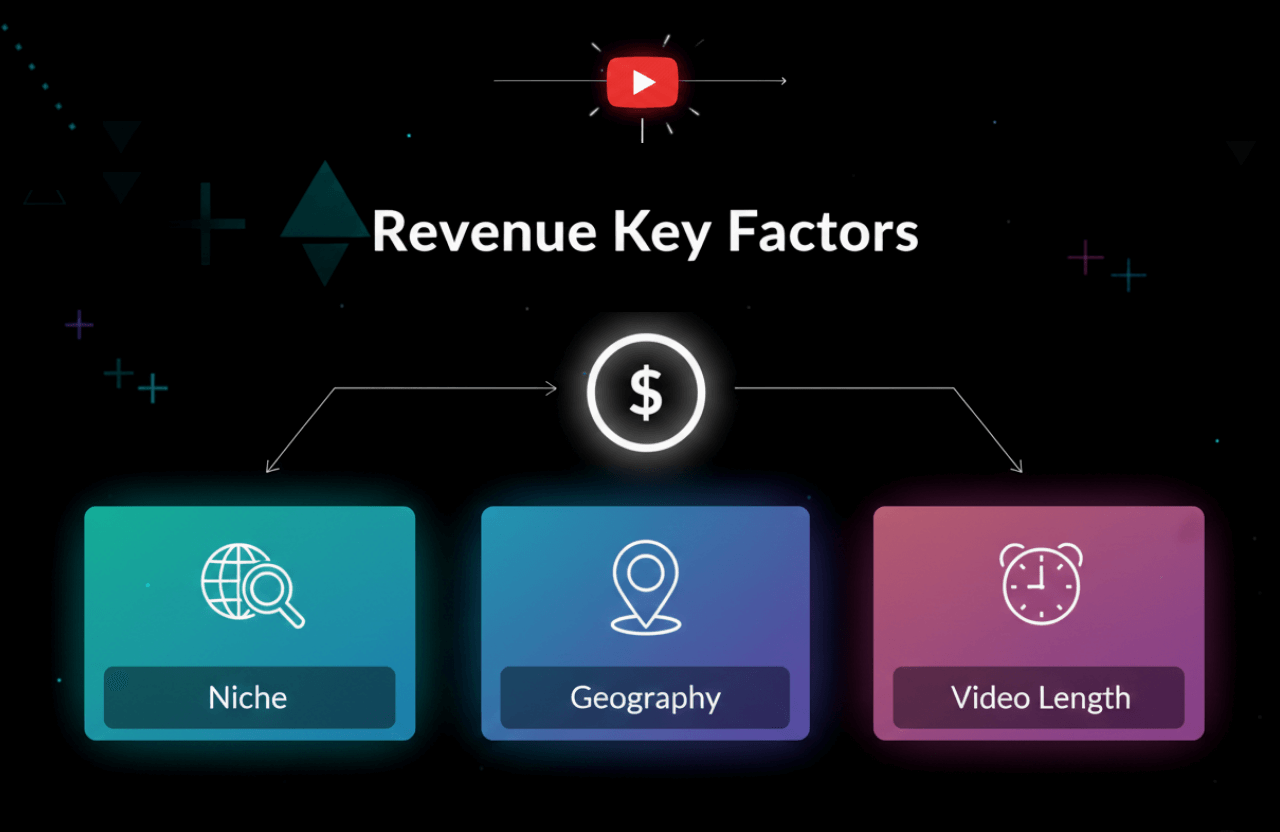
Ever wonder why one YouTuber buys a sports car with a million views while another struggles to pay rent? The algorithm that decides your payout basically looks at three things: Niche, Geography, and Format.
If you want to squeeze every dime out of your views, focus on these proven strategies:
1. Niche Selection: The Biggest Factor
Your topic is the ultimate dealbreaker here. Brands will happily throw cash at audiences who actually have money to spend or intend to buy expensive products.
High-Paying Niches (CPM: $15 - $50+):
Finance & Investing: Banks, crypto apps, and insurance companies bid like crazy here. One good customer is worth a fortune to them.
E-commerce & Digital Marketing: Software brands (SaaS) selling to business owners will pay whatever it takes.
Real Estate: High-ticket items naturally attract massive ad budgets.
Tech Reviews: If someone is watching a review of a $2,000 laptop, they are probably about to pull out their credit card.
Mid-Tier Niches (CPM: $4 - $10):
Lifestyle & Vlogs: Tons of people watch, but they aren't necessarily looking to buy anything immediately.
Gaming: Huge, intensely loyal audiences, but they generally skew younger with less cash to burn.
Cooking & DIY: Advertisers here are usually just selling household goods or groceries. The profit margins are slim.
Low-Paying Niches (CPM: $1 - $3):
Pranks & Compilation Channels: Massive views, but the audience is completely random and unverified.
Shorts Compilations: Incredible view counts, but advertisers just don't care about the placement.
Meditation & Sleep Music: People literally fall asleep to these, meaning they never look at or click the ads.
2. Audience Geography: Location Matters
Where your fans live dictates everything. Marketers separate the world into tiers based on purchasing power.
Tier 1 Countries (Highest Pay): USA, United Kingdom, Australia, Canada, Switzerland.
Why? Tons of disposable income and a fiercely competitive ad market.
Tier 2 Countries (Moderate Pay): Brazil, Mexico, Philippines, India, Eastern Europe.
Why? The economies are growing rapidly, but ad spending is still relatively low.
Tier 3 Countries (Lowest Pay): Parts of Africa, parts of Asia, and South America where digital ad infrastructure is still developing.
Tips and Tricks: Plot twist—if you live in a Tier 2 country but you speak English and target an American audience, you get paid American rates. It’s all about where the watcher is sitting, not where you uploaded the file.
3. Video Length and Ad Formats
How you edit your video limits how many ads you can cram into it.
Videos under 8 minutes: You only get pre-roll (start) and post-roll (end) ads.
Videos over 8 minutes: You unlock the holy grail: Mid-roll ads. You can drop commercial breaks right in the middle of your content.
Stretching a video to 10 minutes and tossing in two mid-rolls effectively triples your ad space compared to a 3-minute clip. It’s literally the easiest hack to instantly boost your RPM.
Further reading: Dive deeper into getting your stuff seen with our guide on SEO Onpage VS Offpage Optimization.
YouTube Shorts vs. Long-Form Videos: The Pay Gap
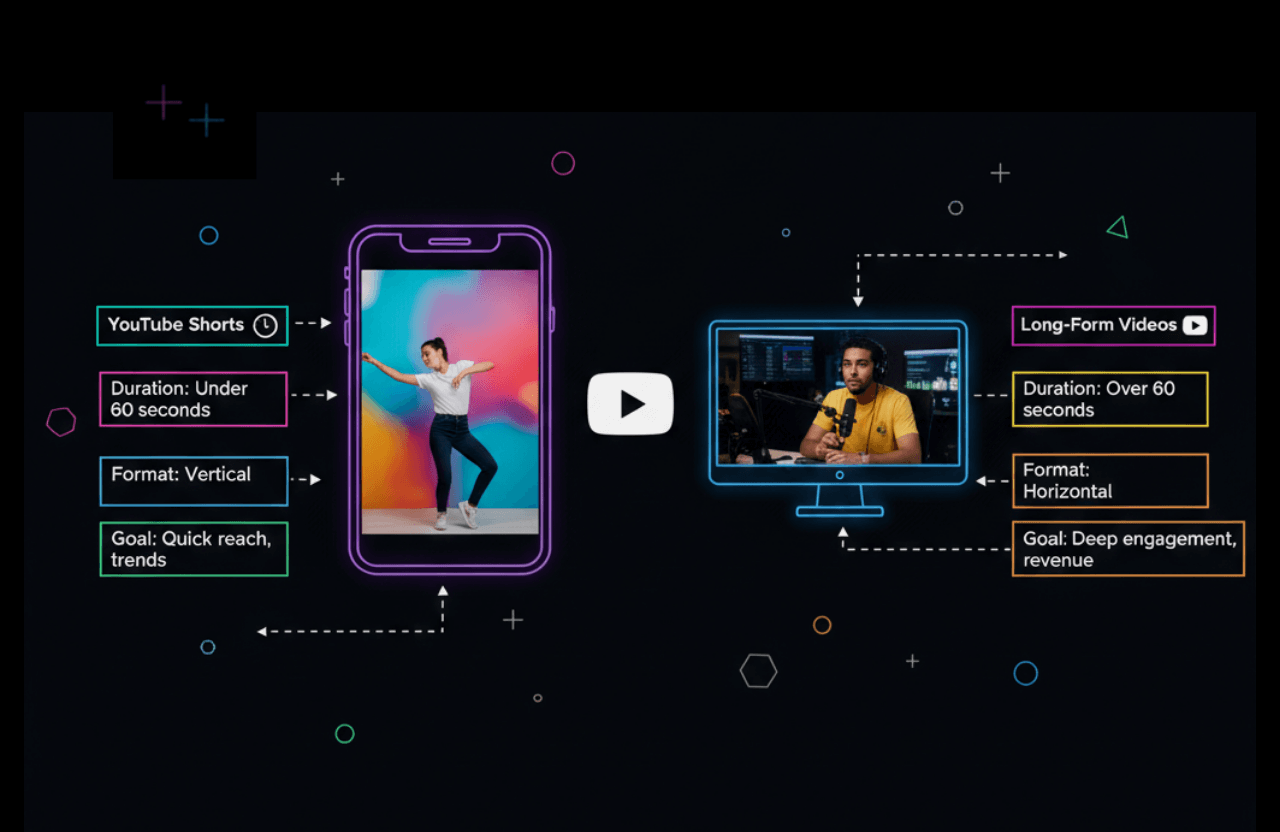
With TikTok totally changing the game, everyone is asking: how much does YouTube actually pay for 1 million views on Shorts compared to a regular video?
The YouTube Shorts Monetization Model
Shorts pay out completely differently. Instead of an ad interrupting your specific video, ads just pop up as viewers scroll through their feed. YouTube throws all that ad money into a massive pool, pays off the music labels, and splits the rest among creators based on view volume.
The Reality: You need an absolute mountain of views to see real money from Shorts ads alone.
The Pay Rate: Most creators are scraping together $0.01 to $0.06 for every 1,000 views.
The Trade-off: Sure, the money is terrible, but the algorithm pushes Shorts so hard that hitting a million views is a hundred times easier than on a 20-minute video. It’s an incredible tool for gaining subscribers and brand awareness.
Comparison: 1 Million Views
Long-Form Revenue: ~$3,000 (Average)
Shorts Revenue: ~$50 (Average)
Strategic Takeaway: Be smart about it. Use Shorts as a giant billboard to grab new fans, then push them toward your long-form videos where the real money is made.
Real-World Scenarios: What 1 Million Views Looks Like
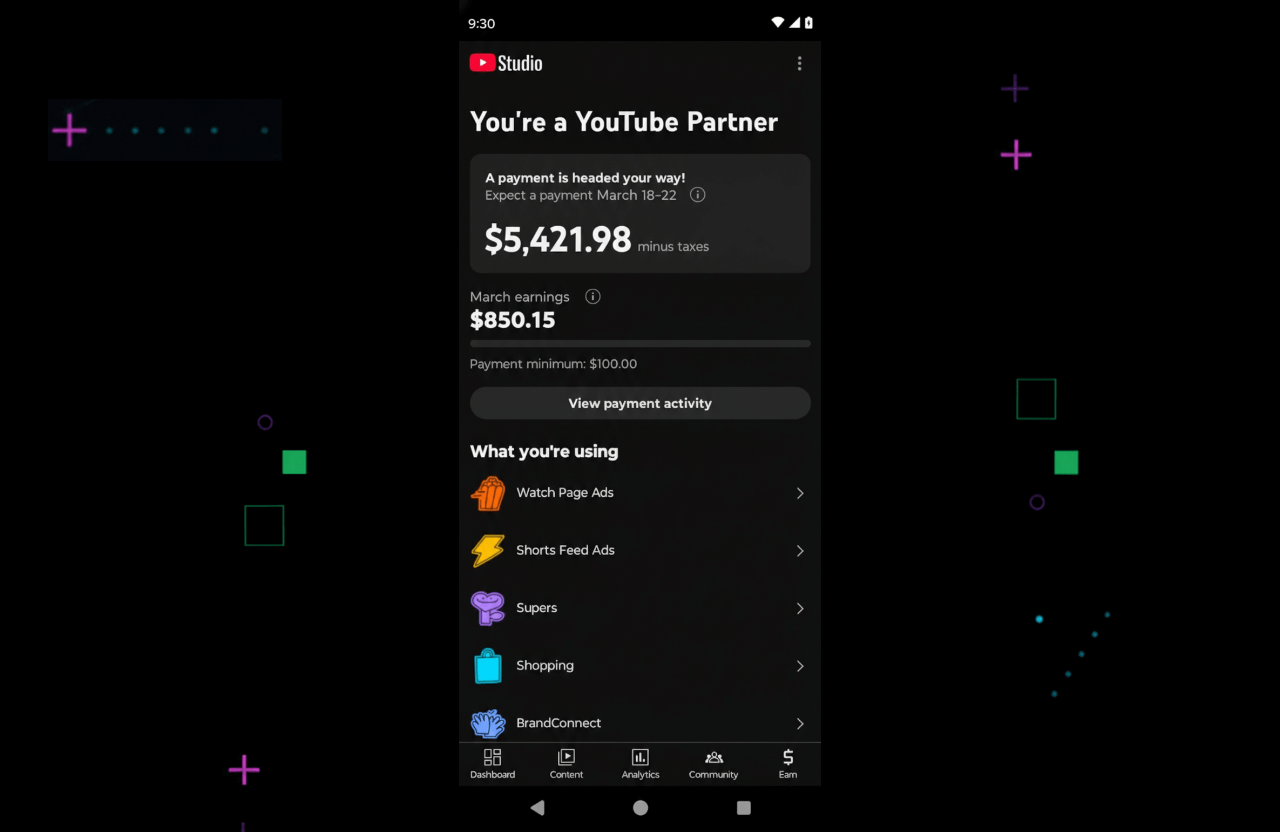
Let’s put this into perspective with two totally hypothetical (but very realistic) examples to show how your topic changes absolutely everything.
Scenario A: The Viral Gaming Channel
Channel Name: "RetroGamerX"
Video Topic: "Funny Glitches in Minecraft"
Video Length: 4 minutes
Audience: All over the place (Mix of US, Brazil, India, Russia), mostly teenagers.
RPM: $1.50
Earnings for 1 Million Views:$1,500
Scenario B: The Personal Finance Channel
Channel Name: "WealthBuilder Pro"
Video Topic: "Best Credit Cards for High Earners 2026"
Video Length: 12 minutes (with 3 mid-roll ads tucked inside)
Audience: Mostly US, UK, and Canadian adults aged 25-45.
RPM: $25.00
Earnings for 1 Million Views:$25,000
The Lesson: Both guys threw a party for hitting a million views, but the finance creator walked away with 16 times more cash just because he targeted an older, wealthier audience and made the video long enough for mid-roll ads.
Further reading: For more ideas on making money on the internet, read up on How to earn 100$ per day.
Beyond AdSense: How to Maximize Revenue
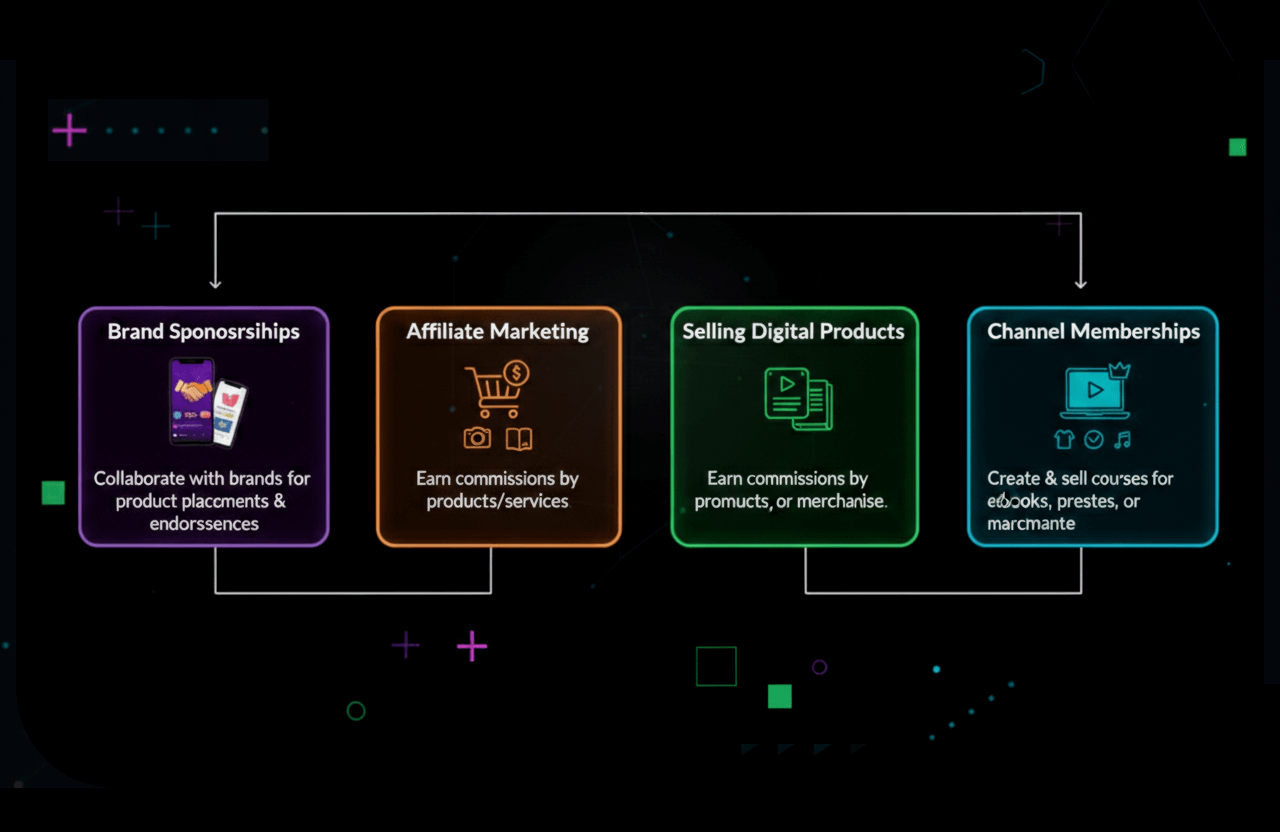
AdSense is nice, but it's rarely the main income source for huge creators. If you want to make serious cash, you need to stack multiple streams of income on top of those views. Here’s how the pros do it:
1. Brand Sponsorships
Brands throw around way more cash than YouTube does. If a sponsor knows your video will hit a million views, they might cut you a check for $10,000 to $50,000 just to talk about them for sixty seconds.
Action: Put together a slick media kit and start emailing brands the second you have a loyal audience.
2. Affiliate Marketing
Dropping a few links in your description box is essentially free passive income.
Example: A tech reviewer linking to the exact camera they use via Amazon Associates, or a software channel dropping a link to a SaaS tool.
Potential: A single viral hit could easily pull in $10,000+ in commissions if the product makes sense for your viewers.
Check out our breakdown on Affiliate vs Referral Marketing.
3. Selling Digital Products
Selling your own custom e-book, video course, or Lightroom presets means you keep 100% of the profits.
Math: Think about it. If 1 million people watch you, and a tiny fraction—like 0.1% (just 1,000 people)—buys your $50 course, you just made $50,000. AdSense will never touch that.
4. Channel Memberships
Give your hardcore fans cool emojis, badges, and exclusive videos for a few bucks a month. It’s brilliant for steady, recurring income.
Common Myths About YouTube Earnings
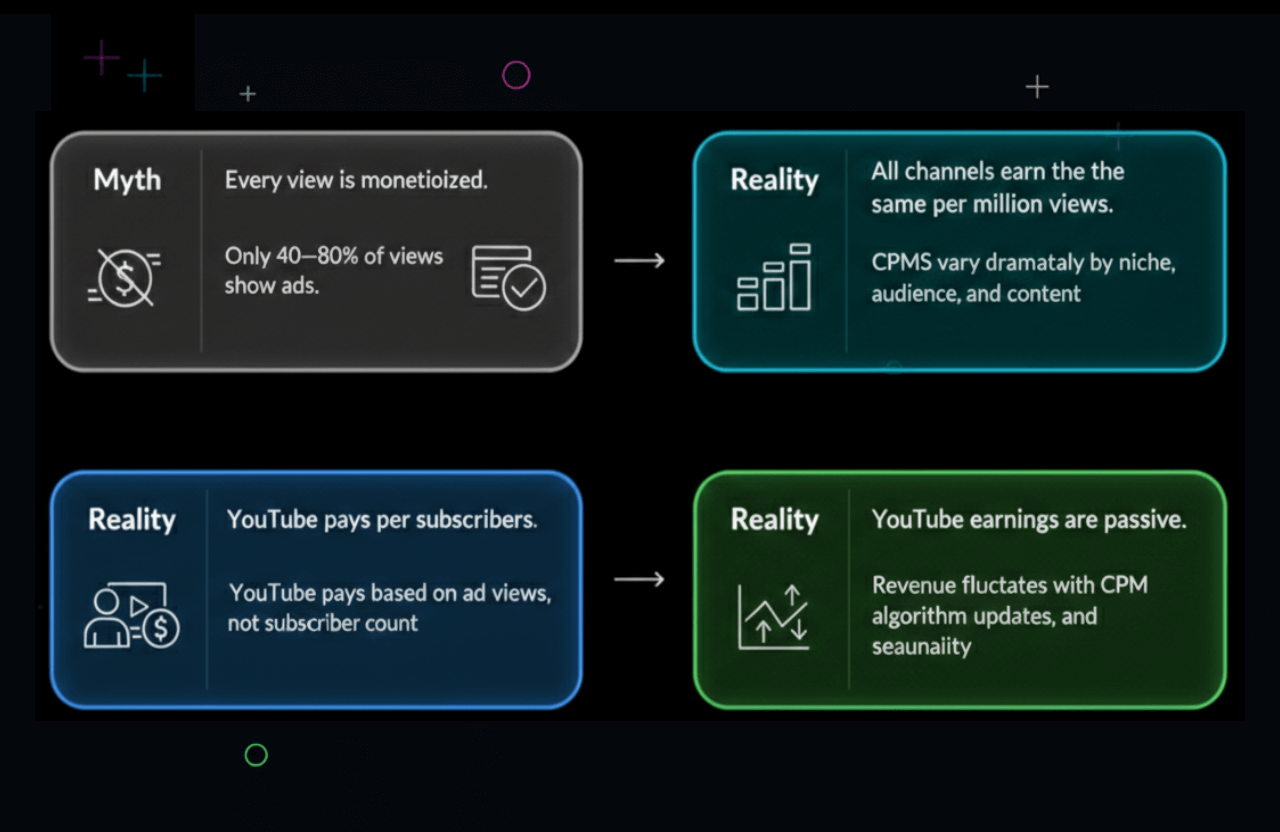
- Myth: Every single view puts money in your pocket. Reality: Nope, usually only 40–80% of your views actually play an ad.
- Myth: A million views pays exactly the same for everybody. Reality: Not even close. CPMs swing wildly depending on what you talk about and who is watching.
- Myth: YouTube pays you a salary based on your subscriber count. Reality: Subs are great for the ego, but YouTube only pays for ad views. You could have 10 million subs and make nothing if nobody clicks the video.
- Myth: It’s 100% passive income. Reality: The money goes up and down constantly based on algorithm changes, advertising budgets, and what season it is.
Essential Tools to Track and Scale Your YouTube Income

Stop guessing. If you want to treat this like a real business and actually boost your RPM, you need to use the tools the pros use:
Social Blade: Basically the industry standard for stalking channel stats. It spits out estimated earnings for literally any public channel, so you can easily spy on your competitors.
VidIQ / TubeBuddy: These browser plugins are absolute game-changers. They tell you exactly which keywords advertisers are overpaying for, letting you tweak your tags and titles to attract higher-paying ads.
Influencer Marketing Hub Calculator: A totally free tool where you punch in your daily views and engagement rates to see what your monthly or yearly paycheck might look like.
Google Trends: The best way to catch a viral wave before it crests. If you are the first person to make a video on a trending finance or tech topic, advertisers will fight over your ad slots.
Frequently Asked Questions (FAQ)
1. Does YouTube pay monthly for views?
Yes, YouTube actually pays out every month through AdSense. If you earned money in January, you'll see it hit your bank account around February 21st—as long as you crossed the $100 minimum threshold.
2. How many views do you need to make $1,000 on YouTube?
Honestly, it totally depends on your RPM.
At an average $2 RPM, you'll need 500,000 views.
If you have a solid $10 RPM, you only need 100,000 views.
Running a high-paying finance channel with a $20 RPM? You'll hit a grand in just 50,000 views.
3. Do you get paid for Shorts views?
You do, but it’s essentially pocket change. Shorts revenue is paid out from a shared ad pool and usually averages around a measly $0.01 to $0.06 per 1,000 views.
4. What happens if viewers skip the ads?
If a viewer slams the "skip ad" button before the 30-second mark (or before the ad finishes), you get nothing for that view. However, you do still get paid just for the ad loading on the screen (impressions), and those annoying unskippable bumper ads always pay out.
5. Can I monetize a video with 1 million views if I am not in the Partner Program?
Absolutely not. You are locked out of the money until you officially join the YouTube Partner Program (YPP). That means hitting 1,000 subs and either 4,000 watch hours on normal videos, or 10 million views on Shorts. If you go insanely viral before you get accepted, YouTube keeps all the ad money.
Further reading: Want to hustle harder? Read our guides on How To Sell On Amazon and our SEO for New Website Checklist.
So, how much does YouTube pay for 1 million views? The honest truth is that a million views is just the starting line, not the finish line.
Sure, you can probably count on a baseline of $2,000 to $5,000 for a decently long video. But the real wealth is made when you stop treating it like a hobby and start optimizing. If you pick a highly profitable niche, attract an older demographic, and stack sponsorships and affiliate links on top of your standard ad money, that single viral video could literally pay your rent for the entire year.
If you want to squeeze every dime out of your channel, focus on high-CPM content. Stop relying on just one income stream. Watch your analytics like a hawk, test out new video styles, and adapt when YouTube inevitably changes its rules again.
Don't just obsess over going viral. Obsess over providing actual value. Build a community that trusts what you say, and advertisers will literally line up to pay you. That is the real secret to taking your channel from a fun side project to a seriously lucrative career.