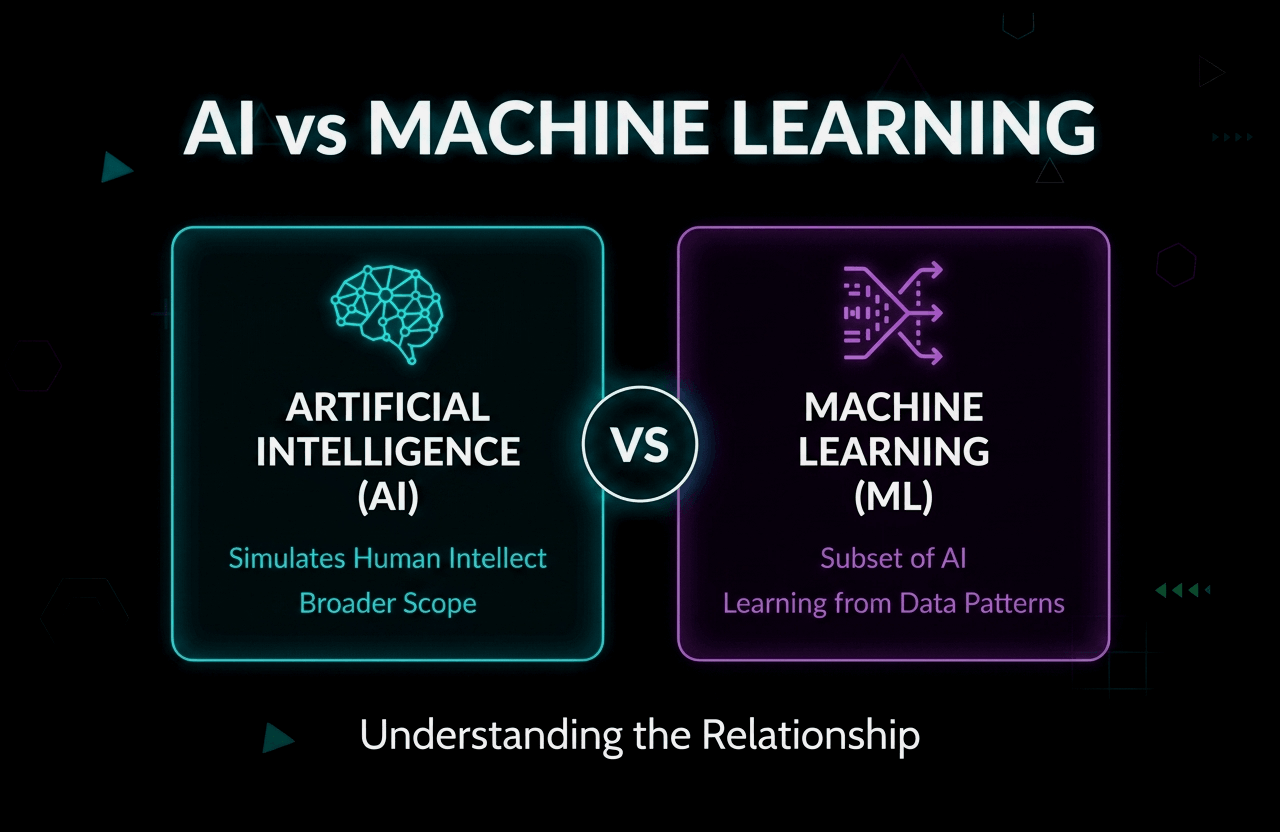
Artificial Intelligence (AI) and Machine Learning (ML) are two of the most influential technologies shaping our world in 2025. But what exactly is the difference between them? If you’ve ever felt confused by the terms, you’re not alone.
AI and ML are often used interchangeably in headlines, marketing, and even technical discussions. Yet, they are not the same. Understanding their relationship, distinctions, and real-world impact is essential for anyone working in tech, business, education, or simply curious about the future.
This comprehensive guide breaks down the key differences between AI and Machine Learning, explains how they work together, and explores why this distinction matters more than ever in the age of generative AI, automation, and data-driven decision-making.
Quick tip: If you want to dive deeper into how language models like ChatGPT fit into this landscape, see our ChatGPT Language Model Explained guide.
AI vs Machine Learning at a Glance
| Aspect | Artificial Intelligence (AI) | Machine Learning (ML) |
|---|---|---|
| Definition | Broad field focused on creating systems that simulate human intelligence | Subset of AI that enables systems to learn from data and improve over time |
| Goal | Enable machines to perform tasks requiring human-like reasoning, perception, and decision-making | Develop algorithms that learn patterns from data and make predictions or decisions |
| Approach | Includes rule-based systems, expert systems, robotics, natural language processing, and more | Focuses on data-driven learning using statistical models and algorithms |
| Examples | Chess-playing computers, voice assistants, self-driving cars, expert systems | Spam filters, image recognition, recommendation engines, predictive analytics |
| Learning | Can be programmed with explicit rules or logic | Learns automatically from data without explicit programming for each task |
Key takeaway: All machine learning is AI, but not all AI is machine learning.
What Is Artificial Intelligence?
Artificial Intelligence is the science and engineering of making machines capable of performing tasks that require human-like intelligence. This includes reasoning, learning, perception, problem-solving, understanding language, and even creativity.
AI is a broad field, encompassing many subfields and approaches. Some of the core areas of AI include:
- Expert Systems: Programs that use a set of rules to emulate the decision-making ability of a human expert (e.g., medical diagnosis systems).
- Natural Language Processing (NLP): Enabling computers to understand, interpret, and generate human language (e.g., chatbots, translation tools).
- Robotics: Machines that can perceive their environment and act autonomously (e.g., warehouse robots, autonomous vehicles).
- Computer Vision: Systems that interpret and process visual information (e.g., facial recognition, object detection).
- Planning and Reasoning: Algorithms that solve complex problems, plan actions, and make decisions (e.g., logistics optimization, game playing).
AI systems can be built using different approaches, including traditional rule-based logic, search algorithms, and, increasingly, machine learning.
Further reading: For a deep dive into AI’s history and branches, see Stanford’s Encyclopedia of Philosophy: Artificial Intelligence.
What Is Machine Learning?
Machine Learning is a subset of AI focused on building systems that can learn from data, identify patterns, and make decisions with minimal human intervention. Instead of being explicitly programmed for every scenario, ML algorithms improve their performance as they are exposed to more data.
Machine learning can be categorized into several types:
- Supervised Learning: The algorithm is trained on labeled data (input-output pairs), learning to predict the output from new inputs (e.g., spam detection, image classification).
- Unsupervised Learning: The algorithm finds patterns or groupings in unlabeled data (e.g., customer segmentation, anomaly detection).
- Semi-supervised Learning: Combines a small amount of labeled data with a large amount of unlabeled data to improve learning accuracy.
- Reinforcement Learning: The system learns by trial and error, receiving feedback in the form of rewards or penalties (e.g., game-playing agents, robotics).
Machine learning is the driving force behind many of today’s most impressive AI applications, from recommendation engines to self-driving cars and generative AI models.
Pro tip: If you’re interested in how machine learning powers SEO and search, see our Search Engine Positioning SEO guide.
The Hierarchy: AI, Machine Learning, and Deep Learning
To fully understand the relationship, visualize it as a set of nested circles:
- AI (outer circle): The broadest field, encompassing all efforts to simulate human intelligence.
- Machine Learning (inside AI): A subset of AI focused on learning from data.
- Deep Learning (inside ML): A further subset of ML using neural networks with many layers, enabling breakthroughs in image, speech, and language tasks.
This hierarchy means all deep learning is machine learning, and all machine learning is AI, but not all AI is machine learning or deep learning.
Further reading: For a technical overview, see MIT’s Explained: AI, Machine Learning, and Deep Learning.
Real-World Examples: AI vs Machine Learning
AI Without Machine Learning
- Expert Systems: Early medical diagnosis programs used hand-coded rules to suggest treatments, with no learning from new data.
- Rule-Based Chatbots: Simple customer service bots that follow pre-set scripts and decision trees.
- Classic Game AI: Chess programs that use search algorithms and heuristics, not learning from experience.
Machine Learning in Action
- Email Spam Filters: Learn from millions of emails to distinguish spam from legitimate messages.
- Image Recognition: Neural networks trained on labeled images to identify objects, faces, or handwriting.
- Recommendation Engines: Netflix and Spotify use ML to suggest content based on your preferences and behavior.
- Voice Assistants: Systems like Siri or Alexa use ML for speech recognition and language understanding.
AI Enhanced by Machine Learning
- Self-Driving Cars: Combine rule-based logic (traffic laws) with ML for perception and decision-making.
- Generative AI: Large language models (like ChatGPT) use deep learning to generate human-like text and answer questions.
- Medical Diagnostics: AI systems that learn from vast datasets to detect diseases in X-rays or MRIs.
Want to see how AI is changing content creation? Explore our guide on Best way to write a prompt for generative AI tools.
Why the Difference Matters in 2025
In 2025, AI and machine learning are everywhere: powering search engines, personalizing ads, driving cars, and even creating art. But understanding the difference is more than a technical detail it shapes how we design, regulate, and trust these systems.
- Transparency and Trust: Knowing whether a system is rule-based or data-driven affects how we interpret its decisions. ML systems can be opaque (“black boxes”), while rule-based AI is more explainable.
- Regulation and Ethics: Laws and guidelines may differ for AI systems that learn from data versus those that follow fixed rules, especially in sensitive areas like healthcare or finance.
- Business Strategy: Companies must choose the right approach for their needs sometimes a simple AI system is better than a complex ML model, and vice versa.
- Skill Development: Learning AI basics is different from mastering machine learning. Understanding the distinction helps you pick the right learning path.
Further reading: For a checklist on how to apply AI and ML to new projects, see our SEO for New Website Checklist many principles apply to data-driven optimization.
Common Misconceptions About AI and Machine Learning
- “All AI is machine learning.” False. Many AI systems use logic, rules, or search algorithms without learning from data.
- “Machine learning is the same as deep learning.” Deep learning is a subset of ML, using neural networks with many layers for complex tasks.
- “AI systems always improve over time.” Only ML-based AI improves with more data; rule-based AI does not learn unless reprogrammed.
- “AI can think like a human.” Most AI, including ML, excels at narrow tasks but lacks general human reasoning and consciousness.
Pro tip: For more on how AI models interpret web content, see our guide on Difference Between Article And BlogPosting Schema Markup With Code Examples.
AI vs Machine Learning in Business and Everyday Life
Understanding the difference isn’t just academic it’s practical. Here’s how the distinction plays out in real-world scenarios:
Business Automation
- AI (Rule-Based): Automated invoice processing using fixed logic and templates.
- Machine Learning: Fraud detection systems that learn to spot unusual patterns in financial transactions.
Marketing and Personalization
- AI: Chatbots that answer FAQs using pre-programmed responses.
- ML: Email marketing platforms that segment audiences and optimize send times using data-driven predictions.
Healthcare
- AI: Scheduling systems that follow hospital rules and protocols.
- ML: Diagnostic tools that analyze thousands of medical images to detect early signs of disease.
Want to see how AI and ML impact online business? Explore our guide on How to earn money from website visits for practical applications.
How to Tell If a System Is AI or Machine Learning
- Check for Learning: Does the system improve with more data or experience? If yes, it uses machine learning.
- Look for Rules: Does it follow fixed rules or logic, with no adaptation? That’s classic AI, not ML.
- Ask About Data: Is the system trained on large datasets? ML systems rely on data to learn patterns.
- Review the Output: Is the output predictable and repeatable (AI), or does it adapt and personalize (ML)?
- Consult Documentation: Product docs or technical papers often specify if ML models are used.
Further reading: For a hands-on approach to AI and ML projects, see our Learn Coding For Kids guide many beginner projects introduce these concepts.
Future Trends: AI vs Machine Learning in 2025 and Beyond
- Generative AI: Large language models (LLMs) like GPT-4 and beyond are pushing the boundaries of what ML can do, generating text, images, and even code.
- Explainable AI: As ML models become more complex, there’s a growing demand for transparency and interpretability.
- Edge AI: More AI and ML systems are running on devices (phones, IoT), not just in the cloud.
- AI Regulation: Governments and organizations are developing policies to ensure ethical and safe use of both AI and ML.
- Hybrid Systems: Combining rule-based AI with machine learning for more robust, flexible solutions.
Pro tip: For more on the intersection of AI and the web, see our guide on Best Search Engines Other Than Google many are powered by advanced ML.
FAQs: AI vs Machine Learning
Is machine learning always better than traditional AI?
No. Machine learning excels at tasks with lots of data and complex patterns, but rule-based AI can be better for well-defined, predictable problems.
Can AI exist without machine learning?
Yes. Many early AI systems and some current applications use rules and logic without any learning from data.
Are all chatbots powered by machine learning?
No. Some chatbots use simple scripts or decision trees (AI), while advanced ones use ML for language understanding.
What skills do I need to work in AI vs machine learning?
AI requires knowledge of logic, algorithms, and sometimes linguistics or robotics. Machine learning requires statistics, programming (often Python), and data analysis.
Summary: AI vs Machine Learning Difference
Artificial Intelligence is the broad science of making machines smart. Machine Learning is a powerful subset of AI that enables systems to learn from data and improve automatically. While ML is driving many of today’s AI breakthroughs, not all AI involves learning from data. Understanding this distinction is crucial for anyone navigating the modern tech landscape, whether you’re building products, making business decisions, or simply staying informed.
As AI and ML continue to evolve, expect the lines to blur further but the core difference remains: AI is the goal, machine learning is one of the main ways we achieve it.
Want to go deeper? Explore our guides on SEO Onpage VS Offpage Optimization and GA4 setup guide step by step with code examples to see how AI and ML are transforming digital marketing and analytics.
Still have questions? Drop them below or check out our recommended resources for more in-depth learning.